Wednesday, April 29, 2026


Why Your 2026 Summer Holiday is Closer Than You Think: Our Top Accessible UK Staycations

[HERO] Why Your 2026 Summer Holiday is Closer Than You Think: Our Top Accessible UK Staycations

Can you feel it? The days are getting longer, the breeze is getting a little warmer, and that unmistakable buzz of summer is just around the corner. It is April 2026, and if you haven’t quite nailed down your summer plans yet, don’t worry, you are certainly not alone! In fact, some of the very best memories are often made when we realize that the perfect escape doesn’t require a long-haul flight or a mountain of complicated paperwork.

At Altogether Travel, we believe that everyone deserves a break that feels like a real holiday. This year, more people than ever are discovering that "staying local" doesn't mean "missing out." Whether you are looking for the salty air of the Cornish coast or the rugged beauty of the Scottish Highlands, your dream 2026 summer holiday is much closer than you think.

In this guide, we want to share why a UK staycation is a fantastic choice this year and how we can help you find that perfect, accessible "home away from home" from our massive database of properties.

The Joy of the Great British Staycation

There is something truly special about a British summer. We might joke about the weather, but when the sun shines on our coastlines and countryside, there is nowhere else quite like it. In 2026, staycations have become a top choice for travelers who want to avoid the rising costs of international flights and the unpredictability of airport queues.

But for our community, a staycation offers something even more valuable: peace of mind.

Choosing to holiday within the UK means you are never too far from home, you speak the language, and you understand the healthcare system. Most importantly, it allows for a much more flexible travel experience. You can pack the car with all those "just in case" items, from extra mobility aids to your favorite pillow, without worrying about luggage weight limits or items being lost in transit.

A car trunk packed with suitcases and a folded wheelchair for an accessible UK summer road trip.

Accessibility Without Compromise

One of the biggest hurdles when planning an accessible holiday is the fear of the unknown. Will the door frames be wide enough? Is the "wet room" actually a wet room? We’ve all heard those stories of "accessible" rooms that turn out to be anything but.

This is where we love to step in. At Altogether Travel, we have spent years building a massive database of accessible self-catering properties across the UK. We aren't just looking for a ramp at the front door; we are looking for properties that truly understand inclusive design.

From cozy cottages in the Cotswolds to modern apartments in the heart of London, we have options that cater to a huge range of needs. Our goal is to ensure you have a variety of choices available without having to compromise on style, comfort, or location. You deserve a beautiful space to relax in, and we are here to help you find it.

If you’re feeling a bit overwhelmed by the options, why not take a look at our vacation planning service? We can take the heavy lifting out of the search for you.

Why 2026 is the Year for Expert Support

We know that for many of our customers, the "holiday" part only starts when the "planning" part is over. Planning an accessible trip can sometimes feel like a full-time job. That is why we emphasize the importance of expert support.

Altogether Travel isn't just a travel agency; we are a registered care service. We hold ourselves to the incredibly high standards set by the Care Inspectorate. This means that when we help you plan your trip, we aren’t just thinking about the hotel, we are thinking about your well-being, your safety, and your comfort every step of the way.

Whether you need a companion to travel with you, help with personal care during your stay, or simply the reassurance that every detail has been double-checked by a professional, we’ve got your back. This level of support turns a potentially stressful experience into a truly relaxing one.


Destination Spotlight: Where to Head This Summer?

The UK is packed with accessible gems. Here are a few of our favorite spots for Summer 2026 that offer great accessibility and even better vibes:

1. The Cornish Riviera

Cornwall remains a firm favorite, and for good reason. Many of its most famous beaches, like Gyllyngvase in Falmouth or Polzeath, now offer sand-friendly wheelchair hire. Imagine rolling right down to the water’s edge to watch the waves! Our database features some stunning self-catering lodges in Cornwall that offer level access and breathtaking sea views.

2. The Heart of Scotland

If you prefer mountains to the sea, Scotland is calling. From the accessible trails around Loch Lomond to the cultural buzz of Edinburgh, there is so much to explore. We even have specific guides to help you out, like our Edinburgh guide or our broader Scotland guide. Scotland’s commitment to "Tourism for All" means more attractions than ever are equipped with Changing Places toilets and sensory-friendly hours.

3. Accessible Urban Adventures

Maybe you fancy a city break? London, Liverpool, and Glasgow are all fantastic options for a 2026 summer getaway. With accessible public transport options and world-class museums that offer excellent facilities, a city break can be surprisingly easy to navigate.

An accessible wooden boardwalk leading to the ocean with a beach wheelchair ready for a summer day.

Making the Dream a Reality: A Stress-Free Process

We often hear people say, "I’d love to go, but I’m just not sure if I can manage it." If that sounds like you, please know that those feelings are perfectly normal. Travel can feel daunting, especially if your needs have changed recently or if you’ve had a difficult experience in the past.

Our approach is all about taking small, manageable steps. Here is how we make it happen:

  1. The Chat: Everything starts with a friendly conversation. We want to hear about your dreams, your concerns, and what "the perfect holiday" looks like to you.
  2. The Search: We dive into our database to find properties that match your specific accessibility requirements.
  3. The Logistics: We handle the details: from transport and equipment hire to arranging support staff if needed.
  4. The Holiday: You go and have the time of your life, knowing we are just a phone call away if you need anything.

Most of all, be kind to yourself during the planning process. It’s okay to ask a million questions: that’s what we are here for! We want to make sure you feel confident and excited about your trip.

A Positive Look Forward

As we look toward the peak summer months of 2026, the mood is one of celebration and inclusion. The travel industry is evolving, and at Altogether Travel, we are proud to be at the forefront of that change. We believe that holidaying is a right, not a privilege, and we are dedicated to breaking down the barriers that stand in your way.

There is a world of beauty right here in the UK waiting for you. From the sunrise over the Norfolk Broads to the sunset behind the Giant’s Causeway, these moments are accessible, they are achievable, and they are waiting for you.

What’s Stopping You?

If you’ve been hovering over the "book" button or staring at a brochure wondering if it’s possible: why not let us help you find out?

Whether you want to explore our services or you just have a few quick questions on our FAQ page, the first step is often the hardest, but it’s also the most rewarding.

Your 2026 summer holiday really is closer than you think. The UK is open, accessible, and ready to welcome you. Let’s make this summer the one where you stop saying "maybe next year" and start saying "I’m so glad I went."

Get in touch with us today, and together, we can make it happen.

We look forward to hearing from you soon and helping you plan the staycation of a lifetime!

Contact Us Today

Tuesday, April 21, 2026

The "Elizabeth Effect" - Why Positive Feedback is an Accessibility Superpower


A quick scroll through social media’s accessible travel groups usually reveals a familiar theme: frustration. We see stories of broken promises, inaccessible "accessible" rooms, and poor information, services, or attitudes.


At Altogether Travel, as a company that accompanies customers worldwide, we’ve seen those struggles firsthand. However, I recently reflected on a regular customer of ours, Elizabeth, who taught us a different way of navigating the world of accessibility.
Elizabeth travels with us to places many would assume are “impossible”—India, Thailand, Vietnam. In terms of strict building codes, these aren't always the most accessible. But what they lack in ramps, they often make up for in a genuine willingness to find solutions. Some of those solutions are... let’s say "unorthodox"... but the heart behind them puts many high-end European resorts to shame.


The Power of the Note Elizabeth’s secret weapon was a stack of thank-you notes. If a waiter went the extra mile or the hotel reception helped get her room just right, she left a note. She believed that while we are all quick to complain when things go wrong, we are far too slow to acknowledge when things go right—or when someone has truly worked to make it right for the guest.
What was most impressive was her "sandwich" technique: she would give genuine praise, then gently point out where a small change could make the experience even better for the next guest. She wasn't just being nice; she was educating them through kindness.


Why Praise Matters I’ll be honest: as a company, we’ve had our fair share of "discussions" with hotels and suppliers that let our customers down. But looking back, I realised we don’t reach out to say "thank you" nearly as often as we should.
I know the counter-argument: “Why should we thank them for doing what they should be doing anyway?”
I get that. But in my role with Altogether Travel, a highlight for me is reading feedback from customers, families, and carers about how our service or holiday companion support made their experience better. That feeling is priceless. It fuels us to do more. Why wouldn't we want to give that same "fuel" to a hotel manager, tour guide, or cabin crew member who is trying to get it right?


What would happen if we all became more "Elizabeth"? Acknowledging an establishment for the good they do—their inclusive attitude, their staff training, or their physical accessibility—isn't just a "nice" thing to do. It’s a way to support businesses that prioritise inclusion.


Let's start "naming and faming" the good ones for a change and leave the ones that don't care in the shadows.
This year, when I’m travelling or visiting attractions, I’m going to make a conscious effort to be more "Elizabeth." A little bit of praise might not change the entire world overnight, but it can certainly change the culture of the business you're standing in.


Finally, I reached out to Elizabeth to tell her I was writing this and asked if she’d like to be featured. Staying true to her humble nature, she sent me a note back that simply said: 'No thanks.'
Even in her refusal, she’s still teaching us: you don't do the right thing for the recognition; you do it because it’s the right thing to do. So, here’s to being more like Elizabeth—quietly making the world a bit better, one note at a time


Wednesday, April 15, 2026


Taking Your Powerchair Abroad: The Ultimate Damage-Free Flight Checklist

[HERO] Taking Your Powerchair Abroad: The Ultimate Damage-Free Flight Checklist

For many of us, our powerchairs aren’t just "equipment", they are our independence, our legs, and our ticket to seeing the world. But we know that the thought of handing over your chair to an airline ground crew can feel a bit like handing over a family member to a group of strangers. We’ve heard the horror stories, and we understand the anxiety.

At Altogether Travel, we believe that everyone should have the chance to explore, whether that’s a city break in Edinburgh or a sun-soaked getaway. That’s why we’ve put together this comprehensive guide with assistance and guidance from a few of our customers.

We’ve helped hundreds of travelers navigate the skies, and we want to share the practical, tried-and-tested steps you can take to ensure your chair arrives at your destination in the same condition it left.

Patience and preparation are key here. By following a methodical approach, you can significantly reduce the risk of damage and fly with a lot more peace of mind. Let’s get into the nitty-gritty of making your flight as smooth as possible.

1. The Research Phase (Before You Even Book)

Not all aircraft are created equal. Some smaller planes have cargo holds with very narrow doors, which means your chair might not even fit unless it’s tilted on its side (which we definitely want to avoid!).

  • Check the Dimensions: Before you click ‘pay’ on those tickets, check the aircraft type. You can usually find this in the flight details. Then, look up the cargo door dimensions for that specific plane. If your chair is 110cm high and the door is only 80cm, you’ll need to know if the backrest can be folded down safely.
  • The 48-Hour Rule: Airlines generally require at least 48 hours' notice if you are traveling with a mobility aid, but honestly, the earlier the better. Why not let them know at the moment of booking? This gives the airline time to ensure they have the right equipment (like an aisle chair) and space available.
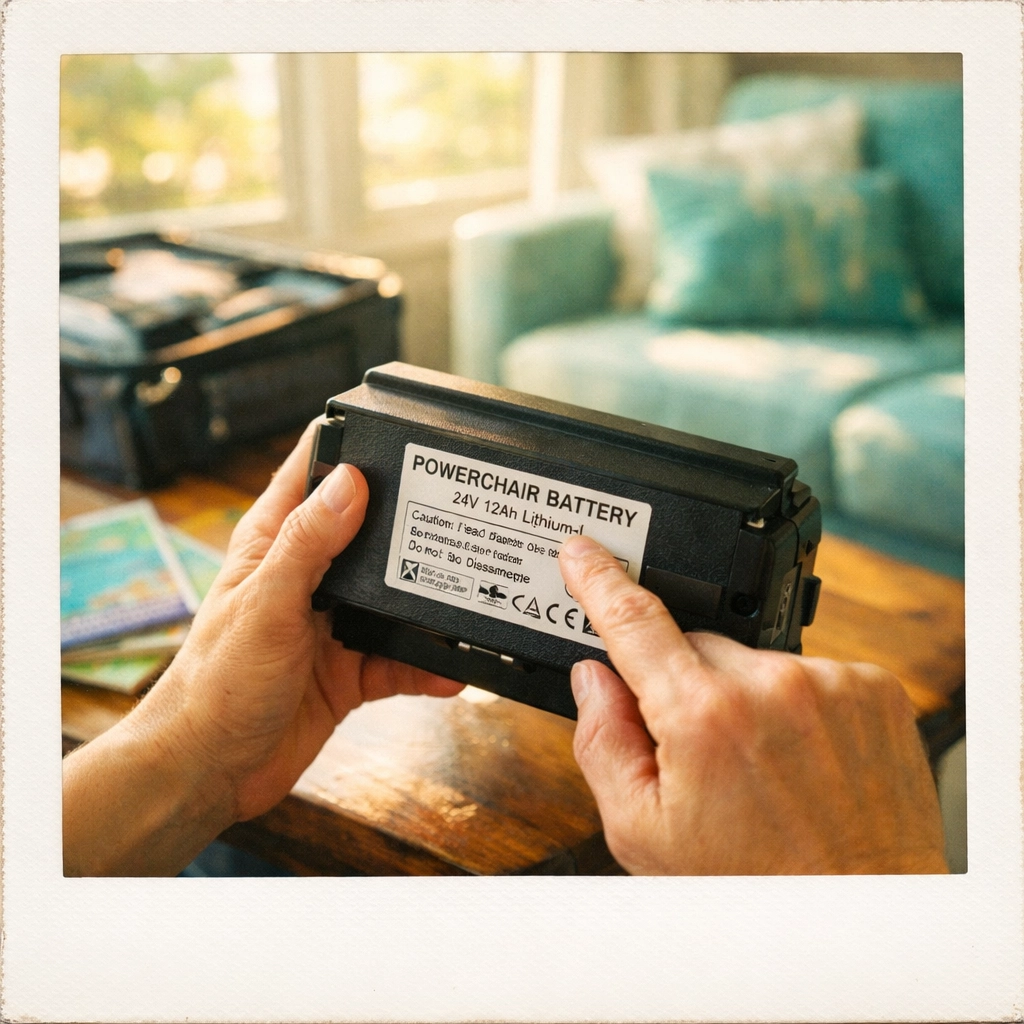
  • Battery Specs: This is the big one. The airline will want to know exactly what kind of battery powers your chair. Is it Dry Cell, Wet Cell, or Lithium-Ion? We’ll dive deeper into this in a moment, but have your manual or a photo of the battery sticker ready.

2. Navigating the Battery Minefield (IATA Regulations)

Batteries are the most common cause of "denied boarding" for powerchairs. Airlines follow strict International Air Transport Association (IATA) regulations because batteries are classified as "dangerous goods."

A traveler checking technical specifications on a powerchair battery before a flight.

  • Lithium-Ion (Li-ion): These are common in modern, lightweight chairs. Usually, you are allowed one battery up to 300Wh, or two batteries up to 160Wh each. If your battery is larger than this, you might run into trouble.
  • Calculating Watt-hours (Wh): If your battery only lists Amp-hours (Ah) and Volts (V), just multiply them together. (e.g., 24V x 10Ah = 240Wh).
  • Dry Cell / Gel / AGM: These are generally easier to transport as they are non-spillable. They usually stay on the chair, but the terminals must be insulated to prevent short circuits.
  • The "Kill Switch": Most airlines require the battery to be disconnected. If your chair has a specific "flight mode" or a physical plug that can be pulled, make sure you know exactly how to do it.

3. Preparing Your Chair for the "Ramp"

Think of the cargo hold as a bit of a bumpy ride. Your goal is to make your chair as "slim" and "protected" as possible.

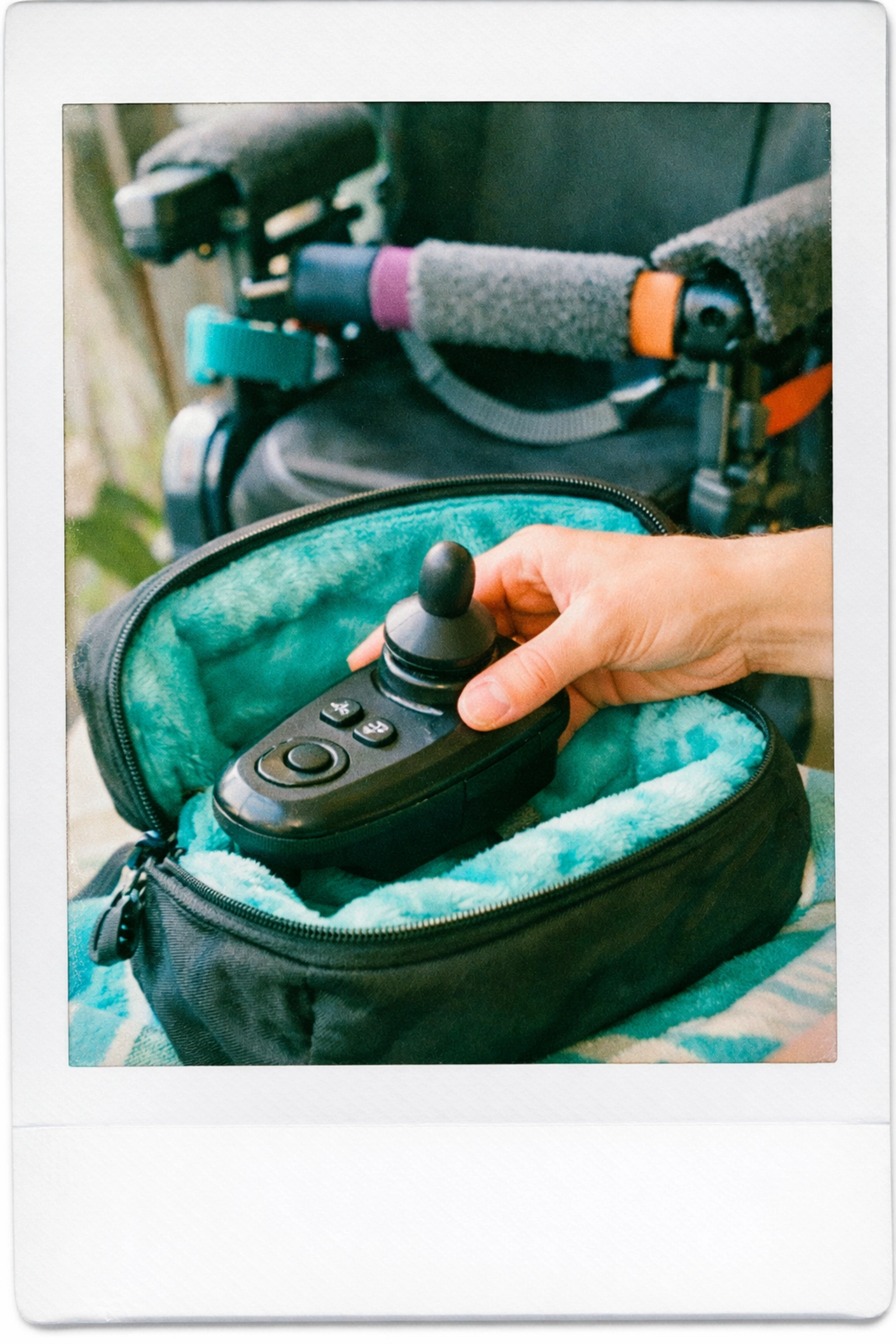
  • Remove the Joystick: This is the most fragile part of your chair. If it gets bumped, your chair is out of commission. Most joysticks can be unplugged and unscrewed. Take it into the cabin with you in your carry-on bag, it’s your "brain," keep it safe!
  • Take Off the Extras: Anything that can come off, should come off. This includes headrests, footplates, cushions, and side guards. Pack these into a dedicated "gate-check bag" or keep them with you. Your cushion is especially important, sitting on a standard airplane seat for hours can be tough on the skin, so we always recommend sitting on your own cushion during the flight.
  • The "Instructions for Dummies" Sign: Don’t assume the ground crew knows how to operate your specific model. Print out a simple, laminated instruction sheet and zip-tie it to the back of the seat. Use large fonts and simple diagrams. Include:
    • How to put the chair into "Freewheel" mode.
    • Where the lifting points are.
    • "DO NOT TILT" or "THIS SIDE UP" instructions.
    • Your contact details.

Placing a detached powerchair joystick into a protective travel bag for safe flying.

4. Physical Protection: Bubble Wrap is Your Friend

It might look a bit silly, but padding your chair can save you a world of heartbreak.

  • Protect the Frame: Use pipe insulation (the foam tubes you get at DIY stores) to cover the metal frame. It’s cheap, lightweight, and snaps right on.
  • Secure Loose Cables: Use Velcro straps or zip ties to ensure no wires are hanging loose. A snagged wire can be just as debilitating as a broken frame.
  • Photo Evidence: Before you hand the chair over at the gate, take high-quality photos and a quick video from all angles. This is your "insurance" if you need to prove the chair was undamaged before the flight.

5. At the Airport: Staying in Control

Arriving early is the best way to reduce stress. For long-haul flights, three hours is a safe bet. This gives you plenty of time to talk to the assistance team and ensure everyone is on the same page.

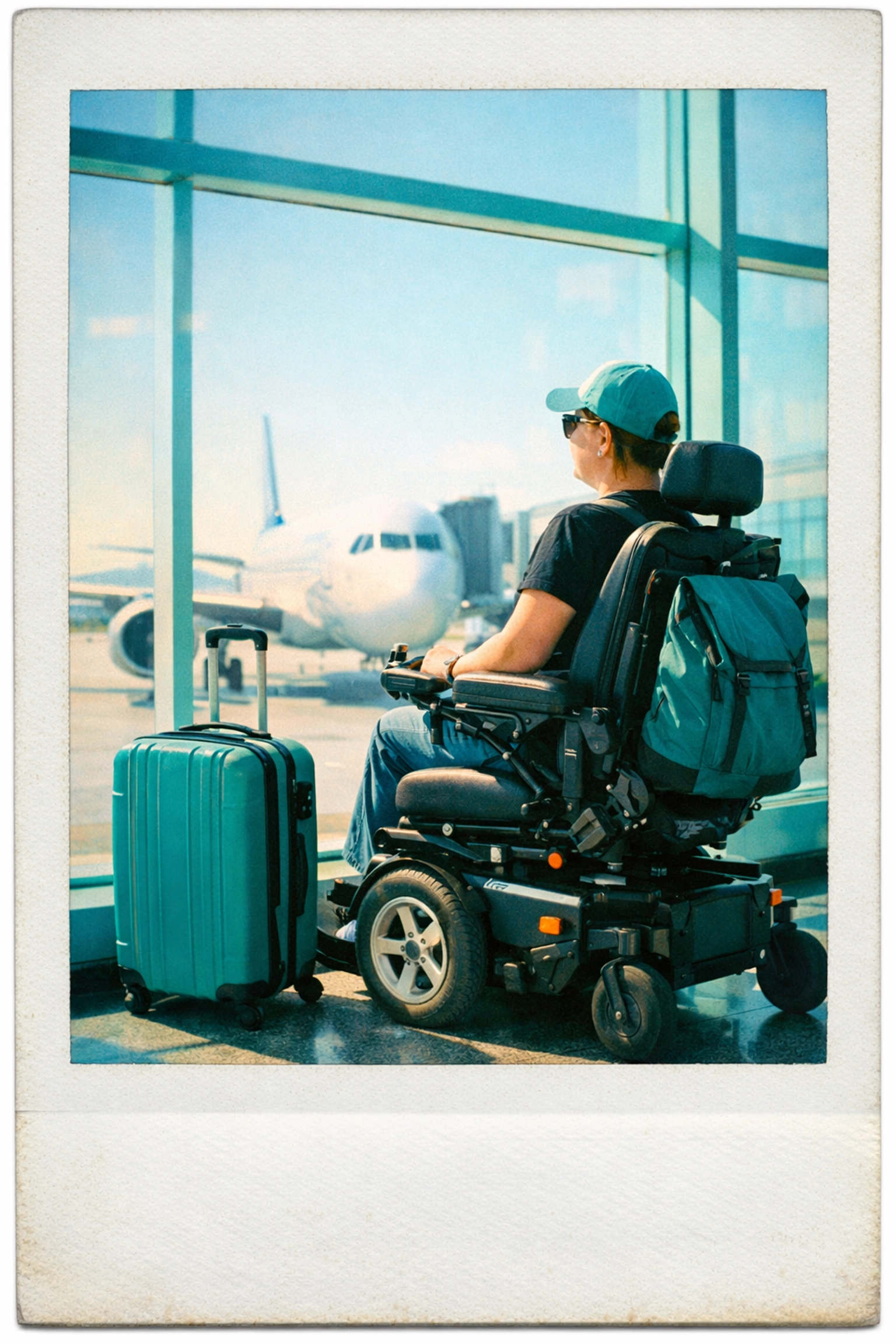
  • Gate Check: We always recommend "gate-checking" your chair. This means you stay in your own chair right up until the door of the plane. This minimizes the amount of time the chair is being handled by baggage systems and allows you to speak directly to the crew.
  • The Ramp Supervisor: If you see the person in the high-vis vest near the aircraft door, don't be afraid to give them a friendly wave and a quick "Hi, that’s my chair! It’s in freewheel mode and the joystick is with me." A little bit of human connection goes a long way.
  • The Aisle Chair: You will likely need to transfer into a narrow "aisle chair" to get to your seat. This can be a sensitive process, so please don't be afraid to tell the assistance staff exactly how you prefer to be lifted or supported. They are there to help, but you are the expert on your own body.

A powerchair user looking out at an airplane at the airport gate before boarding.

6. Arrival: The Moment of Truth

When you land, the airline should bring your chair back to the aircraft door (or as close as possible). Don't feel rushed to get off the plane; often, it’s easier to wait until the other passengers have cleared out so you have space to transfer back into your chair.

  • The Immediate Inspection: Before you leave the airbridge or the gate area, do a full "walk-around" of your chair. Check the joystick connection, the wheels, the backrest, and the battery.
  • If There is Damage: We hope this never happens, but if it does, do not leave the airport without filing a report. You need to find the airline's baggage desk and ask for a Property Irregularity Report (PIR).
  • Document Everything: Take photos of the damage immediately. Get the name of the staff member who helps you and a reference number for your claim. The airline is legally responsible for the repair or replacement of your mobility aid under international agreements like the Montreal Convention.

A Final Word of Encouragement

Traveling with a powerchair requires an extra layer of logistics, but the rewards are so worth it. Seeing the world, meeting new people, and pushing the boundaries of what’s possible is a beautiful thing. Most airline staff are incredibly helpful and want to get you to your destination safely: they just need the right information from you.

By being organized, assertive, and prepared, you’re not just protecting your chair; you’re ensuring your holiday starts the right way. If you’re feeling a bit overwhelmed or want some help planning your next accessible adventure, why not get in touch with us today? We can help with everything from airport accessibility to finding the perfect destination that fits your needs.

You’ve got this! The world is waiting for you, and with a bit of bubble wrap and a solid plan, your powerchair will be right there with you. We look forward to hearing about your travels soon!

Safe travels,
The Altogether Travel Team

Did you know we have guides available to download from our website?

Many people are unsure at first where they could go and how everything works, so we hope this helps to inspire your next holiday with us – ‘...